
The Moravian Historical Society museum and historic site preserves, interprets, and celebrates the rich culture of the Moravians.
The Museum is open daily from 1:00 p.m. to 4:00 p.m. Reserve a guided museum tour today.
Exhibitions at Moravian Historical Society
Permanent Exhibition
The Moravian Historical Society permanent exhibition features an outstanding collection of objects connected to the establishment of the 18th-century Moravian settlements and the significant contributions Moravians made to music, art, education and culture in early America.
Highlights include:
-
Six oil paintings by John Valentine Haidt (1700–1780), the first artist in colonial America to portray chiefly religious topics.
-
The Antes violin: the earliest-known violin made in the American Colonies.
-
A 1776 pipe organ made by David Tannenberg, the most important organ-builder of his time.
-
A rare 18th-century rifle made by Andreas Albrecht at the Moravian settlement of Christian's Spring.
These items are shown together with textiles, furniture, photographs, maps, early American made firearms, tile and iron stoves, case clocks, and much, much more!

Special Exhibitions at Moravian Historical Society
Moravians & the Revolution: Caught in the Crossfire
February 22, 2026–January 17, 2027
Moravians and the Revolution paints a picture of a pacifist community that found itself caught up in a conflict that would ultimately transform its way of life. Moravians in Pennsylvania had to walk a delicate balancing act between their religious ideals of pacifism and the interests of American patriots, the British government, and Indigenous groups in the region. The Revolutionary War tested their desire for freedom from entanglements with the outside world.
First-hand accounts from the Nazareth, Emmaus, and Bethlehem Diaries, as well as objects from the Moravian Historical Society's collection, show what it was like to live in this region during the American Revolution. Original artwork created by Bob McLeod help bring the story to life. McLeod is best known for co-creating and illustrating The New Mutants for Marvel Comics.

Opening Reception for the Exhibition: Sunday, March 1 from 2:00 to 4:00 p.m.

This exhibition is supported, in part, with funding from the Hotel Tax Grant Program through the County of Northampton Department of Community & Economic Development.
Past Exhibitions at Moravian Historical Society
New to Us: Recent Additions to the Collection
New to Us: Recent Additions to the Collection highlights acquisitions from the last decade. Works in the exhibition include the Civil War uniform worn by Brevet Brigadier General William E. Doster (1837-1919), a native of Moravian Bethlehem, Pennsylvania. Doster defended the co-conspirators who had attempted to assassinate Vice President Andrew Johnson and Secretary of State William Seward on the night of Lincoln’s assassination. The exhibition also features pieces of miniature furniture handmade by Eschor Barton Clewell, a former curator at the Society.

May 4, 2025–January 18, 2026

Pleasure gardens were deliberately planned and cultivated landscapes within Moravian settlements. This special exhibit explores the international influences which the Moravians brought together to create their own distinct landscapes and pleasure gardens in Europe and in Pennsylvania. Through collected reminiscences and first-hand observations made by visitors to these early American parks, the exhibit describes varied historic landscapes that are no longer possible to see and experience.
This exhibition was featured in the September/October edition of the Magazine ANTIQUES. You can read the article here.
March 10, 2024–April 13, 2025

This special exhibition featured a display of needle arts work by members of the Lehigh Valley Embroiderers' Guild of America (LVEGA). The LVEGA was established in 1977 to share their love of needle arts.
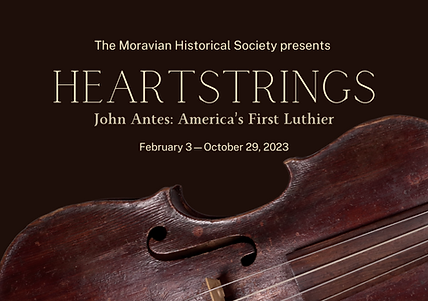
This exhibition brought together three American firsts—a violin (1759), cello (1763), and viola (1764)—all made by the Pennsylvania-born John Antes (1740-1811). The exhibition examined the fascinating life of John Antes and how the trio of Antes instruments came to be reunited. The exhibition also explored how stringed instruments are made and the legacy of lutherie in the Lehigh Valley from Antes to C.F. Martin.
As a luthier, John Antes made seven instruments, only two of which were thought to still exist—the Moravian Historical Society’s 1759 violin and the Lititz Historical Society’s 1764 viola. The Antes 1763 cello was discovered in an attic outside of Pittsburgh. The trio represents the oldest surviving American violin family instruments.
Online Exhibitions at Moravian Historical Society
View our online exhibitions on our Digital Collections site:

